Egypt has more temples than most people can see in one trip, and the good ones are not all in the same place. Some sit in the middle of a modern city, some sit on an island in the Nile, and one was cut into a mountain by a king who wanted the whole world to know who was in charge. If you only have a week or two, these ten are the ones I would put on the list, roughly in the order you would meet them on a southbound journey from Cairo.
A quick note before we start. Ancient Egyptian temples were not places where ordinary people gathered for weekly worship. They were houses for gods, staffed by priests, and the public mostly stayed outside the walls. That changes how you read them. The massive pylons and enclosed courts were designed to separate the sacred from everything else, and the carvings were meant to keep the divine order running. Keep that in mind as you walk through.
1. Karnak Temple Complex, Luxor
Karnak is the big one. It is the largest temple complex in Egypt and one of the largest religious sites ever built, covering close to a full square mile. The ancient Egyptians called it Ipet-Sut, roughly “Most Esteemed of Places,” and it was dedicated mainly to Amun-Ra, king of the gods.
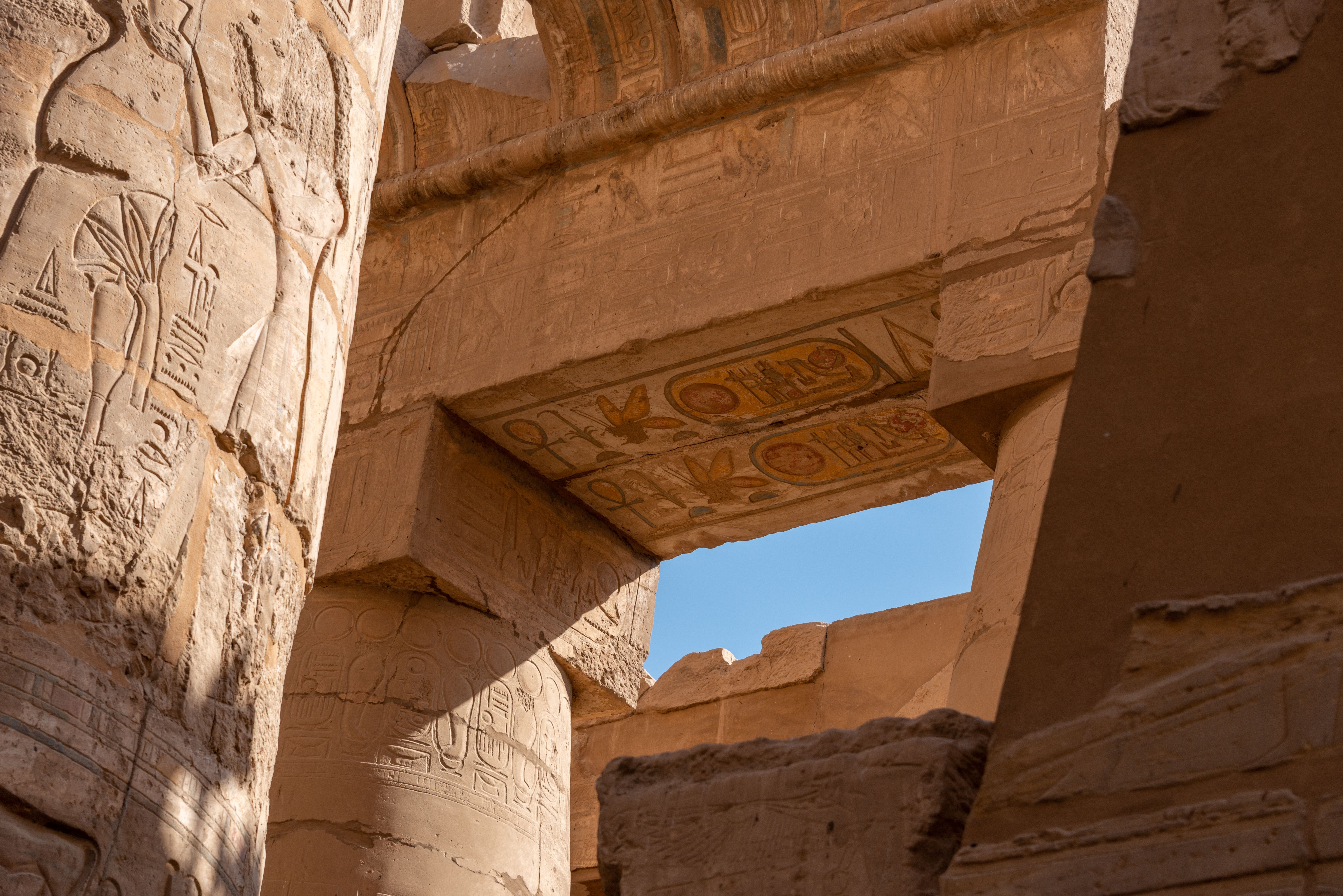
The complex was not built in one go. Over roughly 1,500 years, pharaohs added to it, rebuilt parts of it, and in some cases knocked earlier work down to make room for their own. The result is a site that gets older the farther in you walk. The hall of hypostyle columns is the highlight, a forest of towering, hieroglyph-covered columns that still stops people in their tracks.
Karnak is also where you start to notice how much is still unfinished. Some of the mud-brick ramps used to build the entrance gateway are still there, which is a strangely human detail in a place this grand. For a closer look at the carvings, the surface detail up close is worth more time than you think you have.
2. Luxor Temple

Luxor Temple is smaller than Karnak, but it is easier to love. It was built largely by Amenhotep III in the 14th century BCE and expanded later by Ramesses II, who put two colossal statues of himself at the entrance. Those statues are still one of the first things you see.
What makes Luxor Temple interesting is what happened after the pharaohs. The site was buried under centuries of debris, and later communities built right on top of it. A medieval mosque, Abu Haggag, now sits high up on the temple walls, and early Christian paintings were plastered over some of the older hieroglyphs. It is a layered site in a literal sense. If you are in Luxor, go in the evening. The complex is floodlit after dark, and the columns look far more dramatic than they do at noon. If you plan to continue south from Luxor toward Aswan, traveling along the Nile is a good way to connect several of the major temple sites. Some visitors choose to book a Dahabiya Nile Cruise instead of arranging separate transfers and hotel stays, allowing more time to enjoy the journey between stops.
3. Temple of Hatshepsut (Deir el-Bahari)
Across the river on the West Bank, the temple of Hatshepsut rises in three terraces against a limestone cliff. It is one of the most striking architectural settings in Egypt, and it was built for one of the few women who ruled Egypt as pharaoh. Hatshepsut’s reign was long and productive, and the temple celebrates her divine birth and her expedition to the land of Punt. Later rulers tried to erase her from the record, and parts of her image were chiseled away, which makes the surviving reliefs all the more valuable.
4. Medinet Habu
Medinet Habu is the mortuary temple of Ramesses III, and it is one of the best places to see large-scale battle reliefs. The walls show the king’s campaigns against the Sea Peoples and Libyan groups, carved in dense, lively detail. It also tends to be much quieter than the famous sites on the East Bank, which is a nice bonus if you want to think without a crowd pushing past you.
5. The Ramesseum

Also on the West Bank, the Ramesseum was the mortuary temple of Ramesses II. It is mostly in ruins now, but the scale of what remains, including a fallen colossus of the king, gives a sense of how ambitious the building was. It is a useful place to see how a pharaoh planned his memorial, even if you can no longer see the full structure.
6. Temple of Horus at Edfu
Edfu is one of the best-preserved temples in Egypt. Dedicated to the falcon god Horus, it was built during the Ptolemaic period, roughly between 237 and 57 BCE, and it has a remarkably complete plan. You can walk through the pylon, the courtyards, the hypostyle hall, and the sanctuary in order, which makes it easy to understand how an Egyptian temple was supposed to function. The walls also carry long inscriptions, including a text about the myth of Horus and Seth.
7. Temple of Kom Ombo
Kom Ombo is unusual because it is a double temple. One half is dedicated to the crocodile god Sobek, and the other to Horus the Elder. The grounds once had living Nile crocodiles, and many were mummified after they died. More than 300 crocodile mummies have been found nearby, and some are on display in a small museum at the site.
The carvings on the back wall are also a favorite among historians. They include what are often described as some of the earliest known depictions of medical instruments, which fits with the ancient belief that Horus had healing powers. If you are visiting Aswan, Kom Ombo is an easy stop, and it is one of the few temples that stays open into the evening.
8. Philae Temple
Philae was dedicated to the goddess Isis, and it was once the center of her cult in the region. The temple was moved to nearby Agilkia Island in the 1960s, when the rising waters of Lake Nasser threatened to submerge it after the Aswan High Dam was built. The rescue effort was a major international project, and the island setting still gives the temple a calm, almost dreamy feel. It is reached by boat, which adds to the experience.
9. Dendera Temple Complex
Dendera is dedicated to Hathor, goddess of love, music, and joy. The main temple is one of the best-preserved in Egypt, and its ceilings still show faded colors. The most famous feature is the zodiac carved on the ceiling of one of the chambers. The original is still on the ceiling in Dendera, though a copy of the circular version was taken to Paris in the 19th century. Visiting Dendera is a good way to see a temple that is still fairly quiet, even though it is close to Luxor.
10. Abu Simbel
Abu Simbel is the one most people remember. Ramesses II had the Great Temple carved into a cliff near the Sudanese border, and four giant seated statues of the king guard the entrance. Each is about 20 meters high. The temple was buried by sand for centuries until it was rediscovered in 1813.
The site was moved in the 1960s, when the Aswan High Dam threatened to flood it. The temple was cut into more than 1,000 blocks and reassembled on higher ground, a huge engineering project that was coordinated internationally. The original orientation also created a striking solar event, with sunlight reaching the inner sanctuary on the king’s birthday and coronation day. After the move, the timing shifted by a day, but the effect is still worth seeing.
Most visitors reach Abu Simbel by flight or an early drive from Aswan. If you want a slower way to see the southern sites, consider a Lake Nasser cruise, which lets you see the lesser-known rescued temples along the water.
How to plan the trip
If you are short on time, focus on Luxor and Aswan. Karnak, Luxor Temple, and the West Bank sites can fill two or three days, and Edfu, Kom Ombo, and Philae are easy add-ons if you are traveling by river.
Whatever route you choose, give yourself time to slow down. The best moments in these temples are often not the famous views, but the small carvings you notice when you stop walking and look up.